 Admin
Admin You Are Probably Googling the Wrong Thing
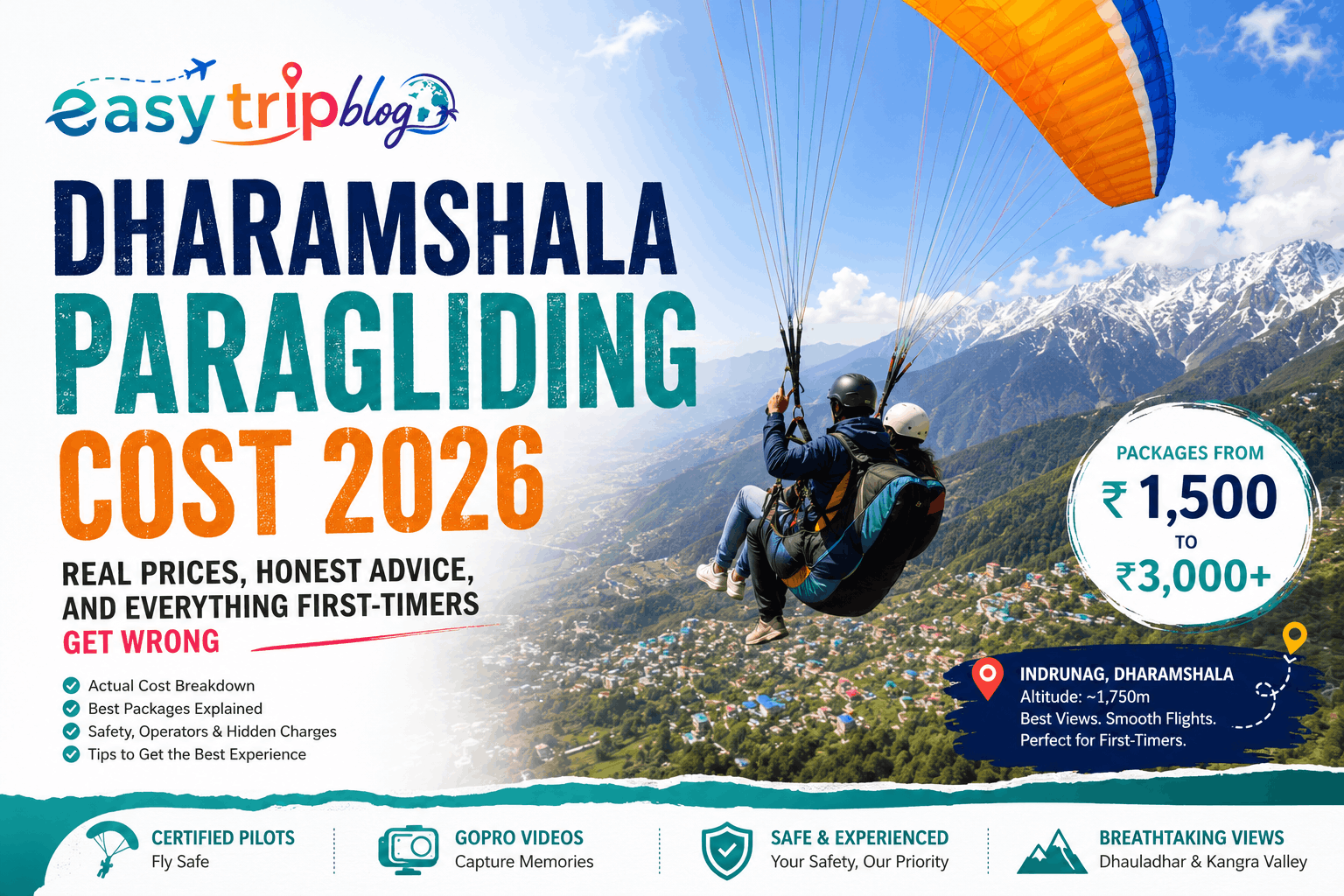
Most people planning a Dharamshala trip type “paragliding cost” into Google and get a number. ₹2,499. Done. Sorted.
Then they show up at Indrunag, and suddenly the number does not match what the operator is quoting. The GoPro is extra. Transport is extra. The “15-minute flight” they booked turns into 8 minutes because the weather shifted. And the operator they chose from a random WhatsApp forward turns out to have no certification.
This guide is not going to give you just a number. It is going to give you the full picture — what you actually pay in 2026, what the different packages really feel like, which operators to trust, what questions to ask before you hand over a single rupee, and the one thing most Dharamshala paragliding blogs will never tell you because it makes the activity sound less glamorous.
Read this before you book. It will save you money, save you a bad experience, and probably make the good experience significantly better.
First — What Actually Happens at Indrunag
Paragliding in Dharamshala takes place at Indrunag, a hilltop, about 3 kilometres from McLeod Ganj bus stand. It’s not the highest paragliding site in India, that title goes to Bir Billing, which we’ll get to later, but at around 1,750 metres above sea level, it’s not too shabby. Indrunag though has what the bigger sites often lack. It is gentle on first timers, the thermals are smooth rather than aggressive and the views are truly world class.
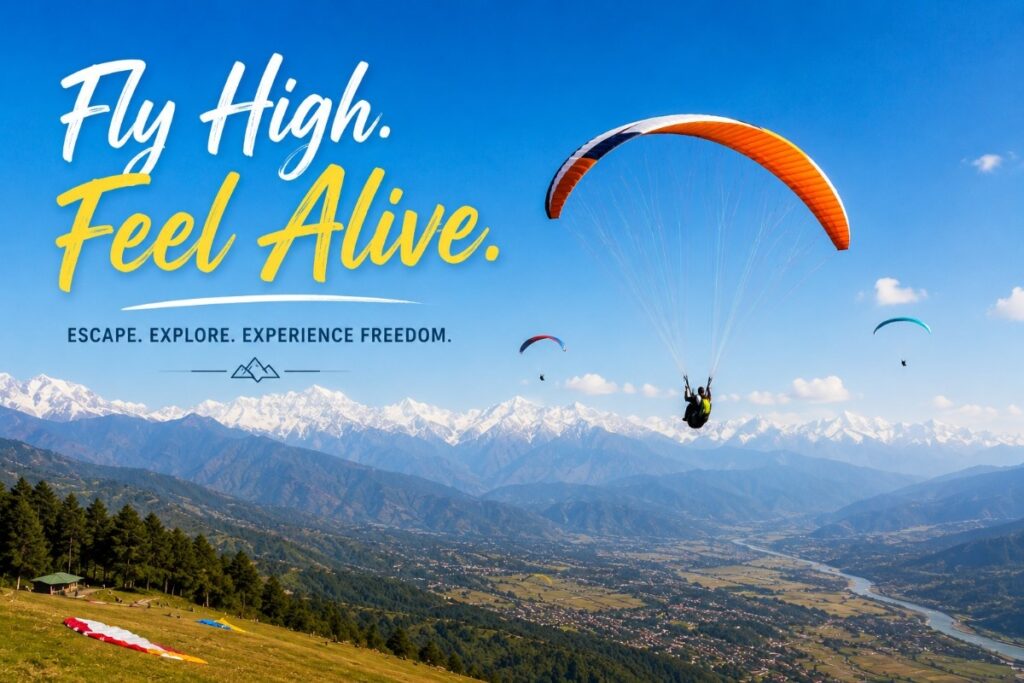
A clear morning arrival at the launch site is first greeted by the scale of the valley below. The Kangra Valley stretches out for kilometres in every direction. On one side is the Dhauladhar range with snow on its upper ridges even through spring. Down in the valley floor you can see the thin silver thread of rivers, the darker squares of tea plantations and if the light is right the distant gleam of Pong Dam. Looks like something straight out of a travel documentary. Soon you will be flying over it.
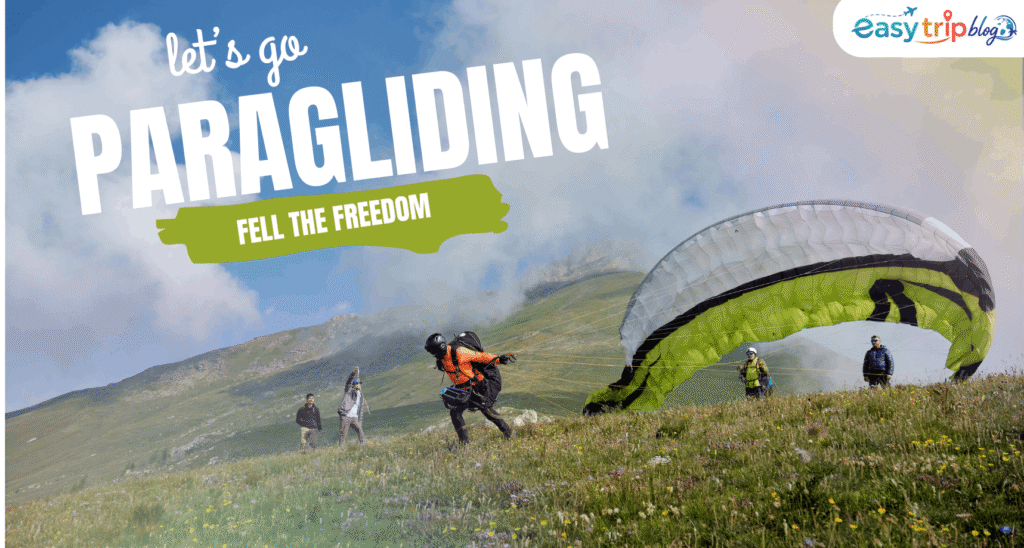
All paragliding at Dharamshala is tandem format. That means you and a certified pilot are physically connected to the same glider throughout the entire flight — you cannot separate, you cannot steer, and you cannot do anything wrong unless you deliberately ignore instructions. The pilot does everything. Your job is to run three or four steps on the grass at takeoff, hold the shoulder straps during flight, and extend your legs when the pilot tells you to at landing. That is it.
The takeoff itself is the moment most first-timers dread in anticipation and then laugh about afterward. You sprint toward the edge, which looks terrifying, and then the ground just — goes. There is no dramatic drop, no stomach-lurching sensation. The glider fills with air and lifts you smoothly. Within ten seconds, you are thirty feet above the launch point and accelerating gently toward the valley. People who expected to scream usually go quiet instead
Dharamshala Paragliding Cost in 2026 — The Actual Breakdown
Let us talk money. Here is what operators are charging at Indrunag in 2026, package by package, with a clear explanation of what each one is actually worth.
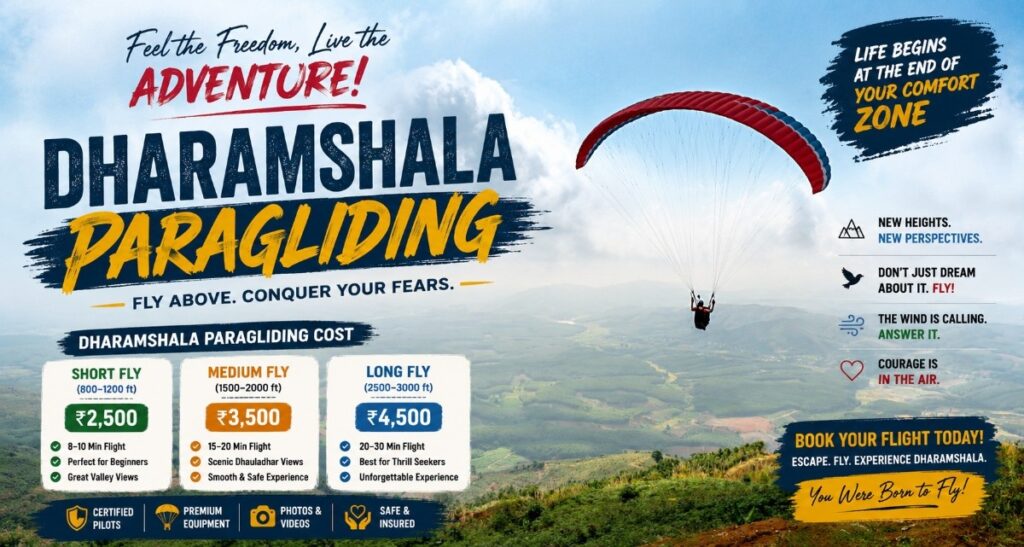
Short Fly — ₹1,500 to ₹2,000 (5 to 10 Minutes)
The short fly exists primarily for travellers who are tight on budget, tight on time, or genuinely unsure how they will handle being airborne. You get the full experience in miniature — proper takeoff, a few minutes over the valley, a supervised landing. Safety gear and a certified pilot are included. Basic insurance is included at most reputed operators, though it is worth confirming the coverage amount before you pay.
The honest problem with the short fly is pacing. Your first two minutes in the air are consumed almost entirely by your own nervous system trying to catch up with what just happened. Adrenaline spikes, your heart rate climbs, you grip the straps tighter than necessary, and you stare at the horizon trying to process that you are genuinely flying. By the time you relax enough to actually look around and take in the valley below you — the pilot is already banking into the landing approach. Most people who take this package land and immediately want to go back up.
If your budget is strict and this is all you can do, it is still worth doing. But if you can find another ₹500 to ₹1,000, put it toward the medium fly. You will not regret it.
Medium Fly — ₹2,499 to ₹3,000 (10 to 15 Minutes)
This is the package most Dharamshala visitors choose, and it is the right call for the majority of first-timers. Ten to fifteen minutes gives you enough time to get through the initial adrenaline surge, settle into the experience, and spend several minutes genuinely present above one of India’s most beautiful landscapes.
Here is what a standard medium fly includes in 2026 and why each element actually matters:
- Certified tandem pilot: Not just any experienced pilot – But one who has a current INHPA (Indian National Hang Gliding and Paragliding Association) or BHPA (British Hang Gliding and Paragliding Association) certification. This is important because certification requires standardised training in emergency protocols, passenger management, weather assessment and equipment inspection. A pilot who has been flying tandem at Indrunag for three years without a certificate is not the same as a certified pilot, no matter how confident he may look on the ground. Ask for the certification card. Every legitimate pilot carries one.
- Full safety harness and wing: The harness connects you to the pilot and both of you to the glider. It should fit snugly around your thighs, waist, and shoulders without pinching. At reputed operators, harnesses are checked before every flight and replaced at manufacturer-recommended intervals. The glider wing itself should be a certified model — not a patched, faded, or visibly worn canopy. Inspect what you are being attached to before you leave the ground. If something looks questionable, say something.
- Helmet: Non-negotiable at every legitimate site. If any operator suggests the helmet is optional, that operator is not legitimate.
- Pre-flight safety briefing: Usually five to seven minutes long, this covers take-off posture (lean slightly forward, match the pace of the pilot, don’t slow down at the edge), in-flight position (relax your body, keep hands on shoulder straps, don’t grab the lines), and landing preparation (extend your legs on the pilot’s signal, prepare to take a couple of running steps on contact). The briefing sounds like a formality. It is not. The most common minor injuries in Dharamshala paragliding happen at landing, and almost all of them are from passengers who did not listen to the landing instruction. Pay attention.
- Basic accident insurance: Included at most reputed operators. Ask specifically what the coverage limit is — ₹50,000 and ₹5,00,000 are both “insurance included” but mean very different things.
- GoPro video: This varies by operator. Some include it in the ₹2,499 to ₹3,000 price. Many do not. Clarify this before you pay, not at the launch site with the harness already on.
Long Fly — ₹3,499 to ₹5,500 (25 to 30 Minutes)
The long fly is for people who already know they will love it, for travellers celebrating something, or for anyone who simply wants to spend as much time above the Kangra Valley as the package allows.
Twenty-five to thirty minutes is a different experience from fifteen. You have enough time to stop registering every sensation consciously and start actually being there. Pilots on longer flights can work the thermals more — gaining a bit of extra altitude, making wider banking turns that show you new angles of the valley, letting you drift over the tea gardens and watch the landscape move below you at the pace of a slow walk. Some operators include acrobatic elements — gentle spirals, steeper turns — on request for passengers who want them.
Premium packages typically include GoPro video, aerial photos, and sometimes complimentary ground transport from McLeod Ganj to the launch site. If you are visiting Dharamshala once and want the full experience, this is the package to choose.
One real limitation to set expectations around: flight duration at Indrunag is partially weather-dependent. A pilot who promises 25 minutes may deliver 20 if thermals weaken or clouds build mid-flight. This is not something operators can control, and it is not a reason to dispute the price. Weather flying is weather flying.
GoPro Video and Photo Add-Ons — ₹500 to ₹1,500 Extra
The most predictable regret after paragliding in Dharamshala, across hundreds of traveller reviews, is not booking the video. Every person who thought “I’ll remember it anyway” lands and immediately wishes they had the footage.
The pricing for 2026:
- GoPro video only: ₹500 to ₹1,000 extra. The camera is mounted on the pilot’s chest or helmet, records the full flight including your reactions and the views below, and is transferred to your phone at the landing zone — usually via WhatsApp or a direct USB transfer.
- Video plus aerial photos combo: ₹1,000 to ₹1,500 extra. Some operators package both together at a better rate than buying separately.
- Acrobatic stunts add-on: A handful of government-certified Dharamshala operators offer aerial manoeuvres — spirals, steep banking turns — for an extra ₹500 to ₹1,500. This is only for travellers who specifically want it; you give explicit consent in advance. Not recommended for anyone with motion sickness concerns.
Book the video at the same time as the flight, not at the launch site. Prices at the site are often higher and more negotiable in ways that waste time when you should be getting ready to fly.
Check Previous Blog: Bir Billing Paragliding Price 2026
What Is In the Package — and What Is Not
This is where a lot of travellers get surprised on the day. Here is what every reputed operator should include and what falls outside the package price.
Standard inclusions at every legitimate operator:
- Certified tandem pilot with current association credentials
- Properly fitted full-body safety harness
- Certified paragliding wing — inspected and maintained
- Helmet
- Pre-flight safety briefing
- Basic accident insurance (confirm the amount)
Common add-ons that are not always included:
- Transport to Indrunag launch site: Most operators do not include this. Indrunag is 3 kilometres from McLeod Ganj; a local taxi or auto costs ₹100 to ₹200 one way. Some premium operators include a pickup service for ₹200 to ₹300 extra or bundle it into long fly packages.
- GoPro video and photos: As covered above — assume this is extra unless explicitly confirmed otherwise.
- Bag storage at the launch site: You cannot carry a bag during flight. On-site storage typically costs ₹50 to ₹100.
Definitely not included:
- Food, water, or snacks at the site
- Personal travel insurance
- Any medical expenses beyond the operator’s basic coverage limit
- Ground transport back to your accommodation from the landing zone at Badol (some operators arrange this; most do not)
Dharamshala Paragliding vs Bir Billing — Which One Should You Book?
This question comes up in almost every Dharamshala travel forum. The honest answer depends entirely on what kind of trip you are on.
Dharamshala (Indrunag) If you are based in McLeod Ganj and have half a day to spare, Dharamshala (Indrunag) is a good option to add a really memorable experience without disturbing your itinerary. The flight is shorter than Bir Billing, the thermals are less dramatic and the regulatory environment for operators is less uniform. But the views are stunning and the accessibility is second to none – a short taxi ride from town, no overnight stay required, slots available most mornings .
Bir Billing is a completely different propositionIt is the paragliding capital of India and hosted the Paragliding World Cup in 2015. It is located about 70 kilometres from Dharamshala. The Billing launch point is at 2,400 metres — 650 metres above Indrunag — and the landing zone is in Bir village at 1,350 metres. This altitude difference creates strong thermals that allow for regular tandem flights of 20 to 45 minutes, and cross-country flights of an hour or more. At Bir Billing, the standard tandem price is between ₹3,000 and ₹4,500 in 2026, and this usually includes HD video. Operators are registered with the Himachal Pradesh Tourism Development Corporation and the Paragliding Association of India here, so safety is more closely monitored than at most other Himachal sites..
The practical reality of Bir Billing from Dharamshala: the drive takes 2.5 to 3 hours each way. Doing it as a pure day trip is exhausting. The better approach is to spend one night in Bir — it is a beautiful village with good cafés and Tibetan monasteries worth an afternoon — and fly the next morning before heading back.
The bottom line: If your Dharamshala trip is your main event and you want a paragliding experience woven into it, Indrunag is the right choice. If you specifically want the best paragliding experience Himachal Pradesh can offer, plan for Bir Billing separately. They are not interchangeable — they serve different kinds of travellers.
Who Can Fly — The Rules That Actually Get Enforced
These eligibility rules apply at Dharamshala’s Indrunag site and are not suggestions. Operators enforce them because violations create real liability.
Age: The minimum flying age at most Dharamshala operators is 16, though a few accept 15-year-olds. The upper limit is 60. Children below the minimum cannot fly regardless of parental permission. Adults above 60 may be considered case by case depending on physical fitness, but most operators decline at the booking stage. If you are travelling with someone near the edges of these limits, call the operator before you travel to the site — not when you are already there.
Weight: Minimum 40 kg, maximum 100 kg. The weight limit exists because the glider wing and the tandem harness are load-rated to specific combined weights. Above 100 kg, the physics of tandem flight become genuinely less safe — not a policy judgment, a structural one. If you are close to the upper limit and the operator seems willing to be flexible about it, that flexibility should concern you rather than reassure you.
Medical conditions: The following situations require you to either consult a doctor before booking or avoid the activity:
- Heart conditions or uncontrolled blood pressure: The adrenaline of takeoff produces a sharp, immediate cardiovascular response. For someone with an unstable heart condition, this can be dangerous.
- Epilepsy or seizure history: A seizure during flight cannot be managed by a tandem pilot who is simultaneously flying the glider. This is not a conditional restriction — it is a firm disqualification.
- Pregnancy: Any stage. The harness compresses the abdomen, and the physical stress of takeoff and landing carries direct risk.
- Recent surgery: The general guidance is to wait at least three to six months after any significant procedure before flying. The specific threshold depends on what surgery you had and how the healing has progressed.
- Severe back or spinal conditions: The harness seating position applies sustained pressure to the lower spine. For someone with an existing spinal issue, this can cause pain or worsen an existing condition.
- Asthma: Not a blanket disqualification, but at least one major operator in Dharamshala specifically lists it as a condition requiring caution. Check your specific situation.
At the launch site, you fill out a health declaration form before flying. Fill it out honestly. An operator who skips this form entirely is an operator cutting corners.
When to Go — A Realistic Month-by-Month View
The best months for paragliding in Dharamshala are not a mystery, but the reasoning behind the calendar is worth understanding so you can make the right call for your specific situation.
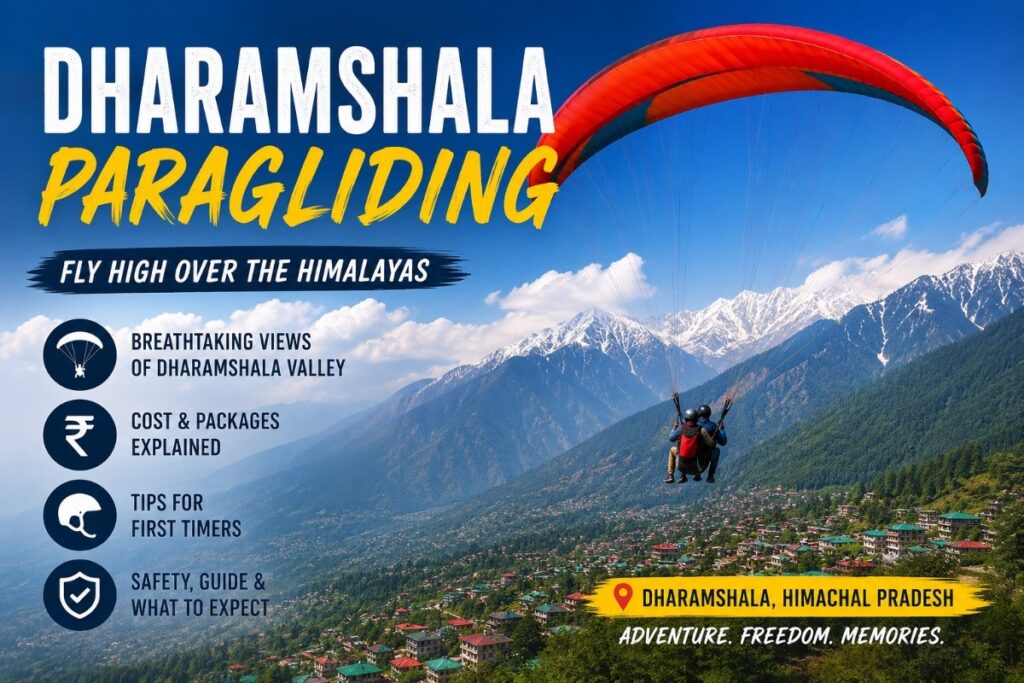
March and April consistently deliver the best conditions across the board. Winter is done, the valley is turning green again, and the skies are clear on most days. Temperatures at launch altitude sit between 10°C and 20°C — cool enough for comfortable flying, not so cold that you need heavy layering. Thermals are building strongly through both months. If you are planning a trip to Dharamshala and paragliding is on your list, March or April is the time to come.
May and June have excellent thermal conditions — stronger winds and warmer air produce longer, more dynamic flights. The views are lush and vivid. The only thing to manage is timing: late May and June see afternoon cloud buildups ahead of the monsoon. Book a morning slot, 9 to 11 AM, and you will almost certainly fly in clear conditions.
July and August — do not attempt to book paragliding during the monsoon. Flights are suspended by every reputable operator. Rain-soaked launch sites, gusty and unpredictable wind, and the risk of a drop stall during wet conditions make this non-negotiable. Some small operators will take your money and fly you anyway. That is a reason to avoid those operators entirely, not a green light.
September and October are genuinely special. The monsoon clears by mid-September, leaving the valley intensely green with fresh vegetation and the peaks carrying new snow. The air is clean and crisp in a way it rarely is the rest of the year. Visibility is routinely exceptional. October is also busy — school holidays and the festive season bring more domestic travellers than almost any other month, so weekend slots at Indrunag can fill up quickly. Advance booking is worthwhile.
November is quiet, cold, and clear. The hillsides are turning dry, the crowds have thinned considerably, and operators are easier to negotiate with. Bring a proper windcheater — at 1,750 metres in November, the air in flight is genuinely cold.
December through February — flying happens on suitable days, but winter weather at Indrunag is inconsistent. Snowfall at higher elevations occasionally affects road access to the site. If you are visiting Dharamshala in winter for other reasons and want to try paragliding, check conditions directly with an operator in the days before you want to fly rather than booking weeks ahead.
Check Previous Blog: Zipline in Rishikesh
How to Book Without Getting Ripped Off
There are two ways people book paragliding in Dharamshala and the difference in outcome between the two is significant.
Spot booking at the site is how most walk-in travellers do it. You arrive in McLeod Ganj, someone approaches you with a brochure, or a taxi driver suggests a contact, or you find an operator through a WhatsApp group. You agree on a price, get driven to Indrunag, and fly. This works fine when you land on a reputed operator. The problem is that there is no easy way to verify credentials quickly on the street, and the worst operators are often the ones most aggressively recruiting walk-in tourists.
Online advance booking through platforms like Thrillophilia, MakeMyTrip, or Trip Tradition gives you something spot booking does not — a paper trail. Listed operators have verifiable reviews, transparent pricing, and written cancellation policies. You can read what travellers from the last three months actually experienced, confirm what is included before you pay, and arrive at the site knowing exactly what you have booked. During peak season in April and October, advance booking also means a guaranteed slot rather than a two-hour wait.
Before confirming any booking — online or in person — ask these specific questions:
- “Can I see the pilot’s INHPA or BHPA certification?” A certified pilot will have a card and will show it without hesitation. Stalling, deflecting, or offering a vague assurance instead of a card is a red flag.
- “Is GoPro video included, or will there be a separate charge at the site?” Get this confirmed clearly. A WhatsApp message that says “video included” is enough. You have it in writing and can reference it if the story changes at the launch point.
- “If the weather prevents flying, what happens to my payment?” The correct answer is a full refund or a free rescheduled slot. Any other answer indicates an operator who will find reasons the weather is “fine enough” rather than refunding you.
- “What is your Himachal Tourism registration number?” Government-registered operators can provide this immediately. It is not a trick question or a difficult ask — it is a standard credential for any legitimate adventure tourism business in Himachal Pradesh.
- “What is the insurance coverage amount?” Not “is insurance included” — that question gets a yes from everyone. The coverage amount tells you how seriously the operator takes their responsibility to you.
On cancellation policies in 2026: Most reputed operators allow cancellation up to 48 hours before the flight for a full refund. Within 48 hours, the standard policy is no refund unless the cancellation is the operator’s decision due to weather. Read the specific terms of whoever you book with — the general rule has exceptions.
What to Wear and What to Leave Behind
Getting the clothing right matters more than most people expect. Comfort in the harness, grip on the launch slope, and warmth at altitude all come down to what you wore before you drove to Indrunag.
Wear these:
- Fitted, flexible clothing: Jeans, fitted track pants, or sports trousers work well. The critical word is fitted. Loose fabric — baggy trousers, flowing kurtas, large hoodies — catches wind and can interfere with the harness or the pilot’s arm movement. You do not need technical outdoor clothing; regular comfortable clothes that stay close to your body are fine.
- A light windcheater or jacket: The temperature at 1,750 metres is noticeably cooler than in McLeod Ganj town, and the wind chill during flight adds to that. Even on a warm April afternoon, you will want a thin jacket for the flight itself. Bring one regardless of what the ground temperature feels like.
- Grip-sole closed-toe shoes: Sports shoes or trekking shoes are ideal. Sandals, slippers, heels, and open-toe shoes are not allowed. The reason is entirely practical — you run on uneven grass at takeoff and take landing impact through your feet. You need grip and ankle support for both moments.
- Sunglasses with a secure fit: At altitude with wind, loose sunglasses will either fly off your face or require you to grab them instead of holding the straps. Wraparound styles that sit snugly are far better than fashion frames.
- Hair tied back: Long hair blowing across your eyes at 1,750 metres in moderate wind is both uncomfortable and briefly disorienting. Bring a hair tie as backup even if you think your hair is secured.
Leave these behind:
- Backpacks and bags: You cannot carry them during flight. Leave them at the site’s storage point (typically ₹50 to ₹100 for the duration of your flight) or in your transport.
- Loose jewellery: Necklaces, dangling earrings, and open bangles can catch on harness components during fitting or in flight. Remove them before you arrive at the launch site.
- Your phone in your hand: Many travellers want to take their own phone video. Pilots at reputed operators will tell you this themselves, but it is worth knowing: holding a phone in your hand during takeoff occupies both hands that should be on the shoulder straps. If you want personal footage, book the GoPro. If you are determined to use your phone, secure it in a chest mount and confirm with your pilot beforehand.
- A large meal in the two hours before flying: Altitude change combined with the physical motion of flight can cause nausea in people who are flying on a full stomach. Eat something light and easily digestible — a banana, toast, a small snack. Avoid alcohol entirely, both as a matter of safety regulation and common sense.
The Safety Conversation Most Blogs Skip
Most paragliding guides end with “it is perfectly safe.” This one is not going to do that, because it is not the full picture and you deserve the full picture.
Tandem paragliding at a reputed operator in good weather is a low-risk activity. Thousands of flights are completed at Indrunag every year, and the overwhelming majority of them are incident-free. Traveller reviews from 2026 at operators like Adventure Dharamshala, Bhagsunag Adventures, and BEST Paragliding consistently describe professional pilots, calm experiences, and safe landings.
But accidents happen at Indrunag. A detailed incident report from a traveller in 2025 described a crash during takeoff at a higher-altitude launch point — the glider fluttered and collapsed, the passenger fell from approximately 35 to 40 feet, and sustained multiple fractures including spinal injuries. The pilot lost consciousness briefly. The root cause was inadequate safety procedures and inadequate pilot preparation at that specific launch point, with that specific operator.
This is not an argument against paragliding. It is an argument for choosing the right operator. The Himachal Pradesh government has opened many new paragliding sites across the state, and not all of them have the safety culture or infrastructure of established sites. At Dharamshala specifically, the range of operators runs from genuinely professional to dangerously casual, and they are often within shouting distance of each other at the same launch area.
What actually protects you:
- Verifying certification before you commit. Not after. Before.
- Looking at the equipment you are being asked to wear. A well-maintained harness looks clean, the stitching is intact, the buckles click firmly. Worn, faded, or frayed gear is a visible warning.
- Booking through a platform with recent, verifiable reviews rather than off a street recommendation.
- Not flying when conditions are uncertain. A pilot who is confident about flying in borderline weather when you are anxious about it is not necessarily right and you are not necessarily wrong.
- Following the safety briefing as though the instructions were written specifically for you. Because in the situations where they matter, they were.
Hidden Costs Worth Knowing in Advance
The price difference between what you see advertised and what you actually spend on the day is predictable. Here is the complete picture:
- Transport to Indrunag launch site — ₹100 to ₹200 one way by local taxi or auto from McLeod Ganj. Budget ₹300 to ₹400 for a return trip if you are not arranging separate transport.
- GoPro video — ₹500 to ₹1,500 extra if not included in your package. Agree on the price before takeoff.
- Aerial photos — ₹300 to ₹500 separately, or included in video combos at some operators.
- Bag storage — ₹50 to ₹100 at most sites.
- Return transport from Badol landing zone — The landing site is 6 to 7 kilometres from the launch point. Some operators arrange return transport; most do not. A local taxi back to McLeod Ganj from Badol costs ₹150 to ₹300. Confirm this with your operator before the flight so you are not standing at the landing field trying to flag down passing vehicles.
Total realistic per-person spend for 2026 (medium fly package + video + transport round trip): approximately ₹3,500 to ₹5,000. Plan for this number rather than just the advertised package price and you will not be caught short on the day.
Quick Answers — AEO-Ready FAQ Section
Q: What is the paragliding cost in Dharamshala in 2026?
In 2026, paragliding in Dharamshala costs between ₹1,500 and ₹5,500 per person depending on flight duration. The standard 10 to 15 minute medium fly package is priced at ₹2,499 to ₹3,000 and includes a certified pilot, full safety harness, helmet, and basic insurance. GoPro video is an optional add-on from ₹500 to ₹1,500.
Q: Is Dharamshala paragliding safe for first-timers?
Yes, with a reputed operator. All paragliding at Dharamshala is tandem format — you fly attached to a certified pilot who controls everything. No prior training is needed. Safety depends heavily on choosing an operator whose pilots hold current INHPA or BHPA certification and whose equipment is regularly maintained.
Q: What is the best season for paragliding in Dharamshala?
March to June and September to November are the best months. March and April offer the clearest skies and most stable thermals. September and October bring exceptional post-monsoon visibility. July and August are monsoon season and flights are suspended.
Q: Should I choose Dharamshala or Bir Billing for paragliding?
Dharamshala (Indrunag) is more accessible and fits easily into a broader trip. Bir Billing offers longer flights, stronger thermals, higher safety standards, and a more serious paragliding experience. For most first-timers already in Dharamshala, Indrunag is the right choice. For anyone whose main purpose is paragliding, Bir Billing is worth the extra travel.
Q: What is the age and weight limit for paragliding in Dharamshala?
The minimum age is 16 and the maximum is 60. Minimum weight is 40 kg and maximum is 100 kg. These limits are firmly enforced and cannot be negotiated at the site.
Q: What time does paragliding operate at Dharamshala?
Flights run from 9:00 AM to 6:00 PM. Morning slots — particularly 9 to 11 AM — typically have clearer skies and more stable thermals than afternoon sessions.
Is It Actually Worth ₹2,500 to ₹3,000?
At some point every traveller runs the mental calculation. ₹2,500 is a decent restaurant meal, a night in a mid-range guesthouse, a day of local sightseeing. Is 12 minutes in the air really worth it?
Here is the honest answer: it depends what you are comparing it to.
If you measure it against other line items in a travel budget, maybe not. But the people who fly at Indrunag are not usually comparing it to dinner or a hotel night. They are measuring it against what they came to Dharamshala for in the first place — to do something they could not do at home, to break out of the predictable, to have a story worth telling.
The views from 1,750 metres above the Kangra Valley are not available any other way. No viewpoint in Dharamshala, no photograph, no reel you watched before your trip gives you what the air above it gives you. Floating above the Dhauladhar range, watching the valley arranged below you like a map you could step across — that is the product you are actually buying.
The people who skip it because of the cost usually wish they had not. The people who do it almost universally say it was the highlight of the trip.
That is probably the only data point you need.
Check Previous Blog:Best Bungee Jumping in Rishikesh
Dharamshala Paragliding 2026 — At a Glance
| Detail | Information |
| Location | Indrunag, Dharamshala, Himachal Pradesh |
| Takeoff Altitude | ~1,750 metres (5,740 feet) |
| Landing Site | Badol Village (6–7 km from takeoff) |
| Short Fly | ₹1,500–₹2,000 / 5–10 minutes |
| Medium Fly | ₹2,499–₹3,000 / 10–15 minutes |
| Long Fly | ₹3,499–₹5,500 / 25–30 minutes |
| GoPro Add-On | ₹500–₹1,500 extra |
| Activity Hours | 9:00 AM to 6:00 PM |
| Best Season | March–June, September–November |
| Avoid | July–August (monsoon) |
| Minimum Age | 16 years |
| Maximum Age | 60 years |
| Weight Range | 40 kg to 100 kg |
| Type of Flying | Tandem only |
| Training Required | None |
| Nearest Airport | Kangra/Gaggal — ~13 km |
| Nearest Railway | Pathankot Cantt — ~85 km |
| Realistic Total Budget | ₹3,500–₹5,000 per person |
All pricing and details verified against operator listings and traveller reports current as of May 2026. Prices vary between operators and may change during peak season. Confirm directly with your chosen operator before booking.
 Admin
Admin