
 Admin
Admin Let me start with a confession. I almost skipped the zipline.
I had already rafted and camped for two nights on the banks of Ganga at Shivpuri and honestly, I felt like I had ticked the big boxes of a proper Rishikesh trip. My legs ached, my sleeping bag smelt of bonfire smoke and the idea of strapping myself to a cable 70 metres above a river didn’t seem like a priority on my last morning there.
Then my camp bunk mate – a 58 year old school teacher from Jaipur who had never done any adventure activity in her life came back from the zipline with her dupatta flying behind her and the biggest grin I have ever seen on a grown adult. She sat down next to me, took a breath and said , “Beta, woh toh karna hi tha.”
I went and booked my slot that same afternoon.
That is the thing about the zipline in Rishikesh; it doesn’t matter your experience, your age or the number of other activities you have already checked off of your bucket list it is guaranteed to deliver an indescribable feeling (until you experience it yourself) that nearly always shocks even the biggest doubtersit. This guide is my attempt to give you the full picture before you go. Not just the facts, but the context, the feeling, and the things that actually matter when you are standing there deciding whether to do it or not.
Why This Zipline is Not Like Any Other Zipline You Have Done
If you have ziplined at a hill station resort or at some adventure park outside a city, you probably remember it as a fun five minutes over trees and slopes. Nice, a bit exciting, too short. The Rishikesh zipline is a whole other category of experience and I want to explain exactly why before we get into the logistics.
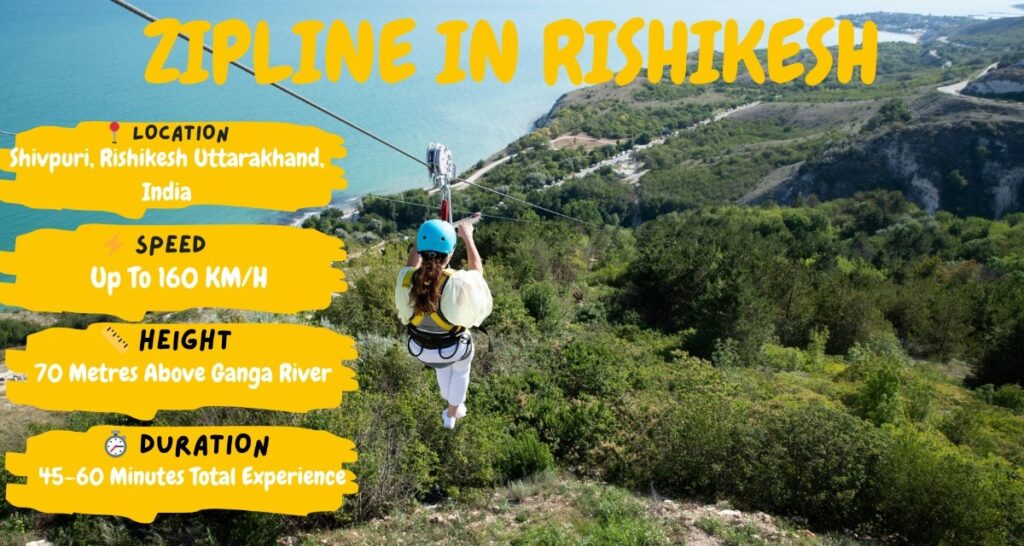
The Shivpuri zipline runs directly over the Ganga River. Not next to it or near it, but directly above the white-water rapids of one of the most powerful river stretches in Uttarakhand. You’re shot from a platform that puts you 70 metres above the water’s surface. From that platform, before the countdown begins, you can see the Ganga churning below in real-time. On busy days you can even watch rafting groups battling the current from up there, which instantly provides you a visceral sense of just how high you actually are.
The cable itself covers around 700 to 800 metres in a two-way trip, and you move across it at speeds between 140 and 160 kilometres per hour. For reference, that is faster than most express trains in India. The Himalayan foothills surround the entire stretch — on a clear morning, the landscape you see while flying is the kind that makes you forget you were ever nervous in the first place.
The activity goes by a few names depending on which operator you go with — Flying Fox, Ganga Zip Adventure or just the Shivpuri zipline — but they’re all the same setup. You do a shorter practice zip first to get the feel for the harness and what it’s like to launch, and then the main ride. “Total time from arrival to landing back, plus safety briefing and gearing up is about 45 to 60 minutes.” The actual flight? A matter of seconds. But the kind of seconds that reset your entire nervous system in a way that an hour of yoga has never quite managed to do for me, personally.
This is also, for the record, the only zipline in Uttarakhand that crosses over the Ganga River. Everything else in the region is over land. That matters because the combination of the water beneath you, the height, the speed, and the mountain backdrop all arrive at the same time and there is genuinely nothing else that replicates that specific feeling.
Where It Is and How to Get There
The Zipline is in a village called Shivpuri that is 15-16 Kms upstream from Rishikesh town along the Badrinath Highway (also known as NH 58). This is the only one thing that you should keep in mind while planning your remainder of the day. A large percentage of people waste ages trying to find the zipline at Laxman Jhula or Ram Jhula and return disappointed. Not near town at all.
Shivpuri is a destination to be understood in its own right.Shivpuri is the adventure capital of Rishikesh and has most of the good camping sites, river rafting start and endpoints and operators for bungee jumping, kayaking, rappelling and cliff jumping working out of Shivpuri or near by areas. So you arriving in Shivpuri to take the zipline is really arriving right in the middle of all the action.
The zipline camp site is near camp Ganga Vatika and once you book with any operator they will share the google map location over whatsapp. Getting from Rishikesh is simple, there are a few great ways depending on your situation.
- Take a taxi/cab from Rishikesh: I believe this is by far the easiest way to get there, if you are in a group of 2 or more people and you want to get there comfortably and have a doorstep service. One way fare of cab is about 300-400. It will take 20-30 mins to get there and the road runs by the river Ganga mostly so the journey itself is a true pleasure.If you are splitting the fare between three or four people it becomes very affordable, and you can ask the driver to wait while you do the activity if you want a ride back without the hassle of booking again.
- Shared jeep or tempo from bus stand: This is the path thatbudget traveler take.Shared jeeps/tempos are always available from Rishikesh bus stand toward Shivpuri etc for a charge of approximately Rs 30 to 50 per person. Disadvantage: They depart only when they are completely filled. If you have a slot booked and a fixed start time, leave yourself at least 30 to 40 minutes of buffer when taking this option so you are not rushing.
- Rented bike or scooter: Honestly, this is my favourite way to cover this particular road. Bikes are widely available for rent in Rishikesh — expect to pay ₹400 to ₹700 for the day depending on the model and rental shop.It is a 20 minute boat trip up the Ganga to Shivpuri, it is mornings like this where the holiday feels more like it is already happening than being a destination. You are in control, to stop as you please, click pictures by the river side, and reach Shivpuri on your own will.
- From Dehradun and elsewhere: The closest airport for those travelling to Uttarakhand from other parts of the country is Jolly Grant near Dehradun, at a distance of 35 kms from Shivpuri. Cabs are readily available at the airport and take about 45 minutes to an hour to reach Shivpuri. The trip from Haridwar would be at a distance of 55kms and will take around 1 and a half hours by cab.
- Check Previous Blog: Dharamshala Paragliding Cost 2026
Pricing — What You Will Actually Pay in 2025
The cost structure in adventure tourism is all rather confusing; there is a slightly different number on every site and operators charge varying amounts for walking in versus booking before you arrive. So here’s the clearest explanation I can offer you.
The base price for the zipline in Rishikesh in 2025 falls between ₹1,600 and ₹2,500 per person. Here is how it breaks down by category:
- Adults (18 years and above) – Most operators charge between ₹1,800 and ₹2,000 for the entire experience of the safety briefing, all equipment, the practice zip and the main ride. Some premium operators with newer equipment or better rated facilities come in at the higher end of this range but the difference in the actual ride experience is minimal . .
- Teenagers/children (ages 10-17) : This category is generally the same as for the whole group, the youngest you can take is generally 10 and the shortest about 4 foot 7. As per usual the prices for these kids will normally range from around 1400-1600. All children under the age of 18 require a signed parental consent form and some operators request the electronically before you turn up. Others prefer you to fill it out on a form on your arrival at the base camp.
- Students with a valid college ID: This one is easy to miss because it is rarely advertised upfront. If you carry your college ID and ask specifically about student pricing, several operators will bring the rate down to around ₹1,250 to ₹1,450. Always ask before you pay — the worst they can say is no.
- Combo with rafting/camping: This is where things get really interesting from a pricing point of view. If you are in Shivpuri for the zipline, it is so much more economical to combine it with river rafting on the same day instead of separate bookings for each. Zipline + rafting combo is typically between 2500-3500 depending on the stretch you chose for rafting. A whole package of zipline, rafting and an overnight stay at a riverside camp will cost between 4000-6000 person all-in including food, tent, bonfire and the activity. It’s one of the most value-for-money adventure packages in North India.
The single most useful piece of advice on pricing: book online at least a day before you go. Platforms like Thrillophilia and AdventuRush consistently offer 15 to 30 percent less than walk-in rates. Booking directly through the operator’s WhatsApp works just as well and sometimes gets you an even better price if you ask for a group discount. Walk-in rates are always higher because the operators know you are already there and committed.
A Proper Walk-Through of the Experience
I want to walk you through this from start to finish in real terms, not the sanitised version you get in a brochure. Because knowing exactly what to expect removes the unnecessary anxiety and lets you actually enjoy every part of it.
You reach Shivpuri base camp and get checked in. If the camp is busy it’s not uncommon to be in line for a few minutes (best to arrive a quarter hour before your assigned time slot). There is always the standard liability form to fill out (Basically, “I’ve read this and understand I could get hurt and I’m capable to do it”). You will give them your ID, verify your reservation, and hang out at the camp until the prior group returns.
The safety briefing is the part that most adventure activity reviews skip over or reduce to one sentence. But it deserves real attention. A proper operator spends 15 to 20 minutes on this. The instructor covers how the harness distributes weight across your body, how to keep your arms positioned during the ride so you do not accidentally interfere with the mechanism, what to do if you feel the harness shift, how the braking system works at the landing point, and most importantly — what you should absolutely not do while on the wire. Operators who rush through this in five minutes are cutting corners, and it is one of the red flags I will come back to in the safety section. Pay full attention even if your brain is buzzing with excitement. The people who listen carefully during the briefing are the ones who have the best experience.
After the briefing, you are fitted with the harness, helmet, and gloves. Watch carefully as the instructor checks each buckle and connection point — not because you need to verify their work, but because seeing the thoroughness of the check is its own kind of reassurance. Nothing gets skipped.
The practice zip comes next.A little hop without crossing the main span of the river. Created simply to show you what it feels like on the launch, on the float, and on landing before you have the full experience. It’s here for the majority of first-time fretters that the activity transforms from one to be feared to one to be anticipated. You land after the practice flight and feel it all differently.
Then the main ride. You climb to the platform — and yes, 70 metres looks very different from the top than it does from the ground below. The instructor makes a final check of your harness, talks you through the launch one more time, and gives you the countdown. What happens next is hard to put into language that does it justice. The Ganga is below, the mountains are everywhere around you, and you are moving faster than your body has probably ever moved outside a vehicle. For those seconds in the air, the noise in your head goes completely quiet. I have never found a better way to describe it than that.
You land on the far side, the retrieval mechanism pulls you back to the starting point, and you step off the platform. Your legs will feel a little strange. You will probably be laughing. The grin is completely involuntary.
Check Previous Blog: Bir Billing Paragliding Price 2026
When to Go and When to Stay Home
Getting the season right matters more for this activity than people often realise.
October through February is the prime window. The air is clear, the views of the Himalayas are sharp and close-looking, and the weather during the activity is as close to perfect as it gets. The evenings get properly cold in December and January so carry a jacket for after the activity. This is peak season and slots fill up fast — book at least two to three days ahead if you are visiting between late October and early January.
Between March and mid June would be my next best choice. Morning, March, and April are fantastic – warm mornings and beautiful green surrounds of Shivpuri due to the last of the winter showers. May is warmer and by afternoon it can actually get hot. If travelling during the summer months, the earliest trip time available is a must-book! 9:00am is a lot more enjoyable than a two o’clock trip on a hot May afternoon.
July through mid-September is the season to completely avoid for this activity. The monsoon shuts down the zipline at most operators — not occasionally, not sometimes, but consistently. Rising river levels, heavy rainfall, and poor visibility make operations unsafe and most operators close entirely from early July through the second week of September. There is no point planning your trip around the zipline during these months because you will most likely find the gates shut.

Safety — The Honest Version
The zipline at Shivpuri is safe. That is the short answer. But it comes with the important qualifier of booking through the right operator, because not everyone operating out of Shivpuri maintains the same standards.
Reputable operators use equipment built to international safety standards — many follow the EN15567 framework used for zipline certification across Europe. Cables, harnesses, and helmets are inspected and replaced on a regular schedule. Instructors are trained professionals who know the activity inside out and who handle nervous participants every single day without making them feel bad about it.
The part of safety that is within your control is your choice of operator. Here is what to verify before you hand over any money:
- Certification and licensing: Ask the operator directly whether they are licensed and which safety standards their equipment meets. A trustworthy operator will tell you without hesitation or deflection. If anyone is evasive about this, walk away regardless of how good their price is.
- The briefing: A full safety briefing is non-negotiable. If you show up and the instructor wants to run through the basics in five minutes and get you on the wire, that is a serious red flag. The briefing exists for your safety and it should be given the time it requires.
- Equipment condition: Look at the harness and helmet they hand you. Equipment should look maintained and functional. Fraying, visible rust on metal components, or faded safety labels are all things to flag before you put the gear on.
- Staff presence throughout the activity: You should have trained staff at the platform, at the landing point, and available during the briefing. You should never feel unsupervised or abandoned at any point in the process.
- Where you book: Use Thrillophilia, AdventuRush, or the operator’s own verified website or WhatsApp. Do not book through random individuals who approach you on the street or near the river in Rishikesh town. The savings are not worth the risk.
There are also people who should genuinely reconsider this activity for medical reasons. Anyone with a serious heart condition, anyone who is pregnant, anyone who has had major surgery within the past few months, and anyone with severe and unmanaged acrophobia should talk to their doctor before booking. Operators will also turn away anyone who appears to be under the influence — this is a firm and consistent rule across all legitimate operators in the area.
What to Wear, What to Bring, What to Leave Behind
This seems small but it makes a noticeable difference in how comfortable and ready you feel when you arrive.
Wear fitted, practical clothing. Track pants or jeans that sit close to the body, a well-fitted T-shirt or sports top, and closed-toe shoes with a firm grip — running shoes or light trekking shoes are ideal. Avoid anything loose or flowing because flapping clothing at high speeds is both uncomfortable and a safety concern. Sandals, chappals, and slip-on footwear are not allowed on the platform under any circumstances — this is a safety rule that operators enforce consistently. If you have long hair, tie it up securely before you start the briefing so it is already done by the time you gear up.
Carry a valid government-issued photo ID, a water bottle, and sunscreen if you are visiting in the warmer months. Between October and February, bring a light jacket or fleece for after the activity — you will not need it during the ride, but once the adrenaline settles and you are standing around at the base camp, the Shivpuri air gets noticeably cooler.
Take off loose jewellery before you arrive at the platform — earrings, chains, bracelets, and rings can catch on the harness. Leave your phone and wallet in your bag at the base camp rather than in your pockets. If you want to capture the ride, ask the operator about their video package when you book. Some operators include a GoPro clip of your ride in the package, others offer it as an add-on. Asking at the time of booking is easier than trying to arrange it on the day.
Make a Full Day of It
The zipline takes about an hour of your day total, which leaves plenty of time to turn it into something larger. Shivpuri genuinely rewards people who stay longer.
River rafting is the most natural combination and almost every operator in the area offers a bundled price for both. The 12-kilometre Marine Drive to Shivpuri stretch is the classic — solid rapids, accessible for most fitness levels, and takes roughly two hours on the water. The longer 16-kilometre Shivpuri to Nim Beach route is more demanding and more rewarding. Doing rafting in the morning and zipline in the afternoon gives your body time to adjust between activities and makes the whole day feel more varied.
Overnight camping along the Ganga turns the trip from a day activity into an actual experience. The camps in Shivpuri are well-run — canvas tents right on the riverbank, bonfires in the evening, simple meals that taste extraordinary after a day outdoors, and the sound of the Ganga all through the night. Many operators offer zipline-plus-camping packages that are genuinely good value, and falling asleep by the river after flying over it earlier that day is the kind of thing you carry with you long after the trip is over.
For those who feel the zipline was just the opening act, the bungee jump at Mohan Chatti — India’s highest at 83 metres — is about 20 kilometres from Rishikesh town. Some groups do zipline plus bungee in a single day. Your legs will feel like they belong to someone else by the end of it, but the stories are worth it.
One Last Thing Before You Book
There is something about the zipline in Rishikesh that I have never seen captured properly in any travel article, and I want to try to put it into words before I close this out.
When you are mid-flight — past the launch, before the landing, somewhere in that gap where you are just moving through the air above the Ganga — everything goes quiet inside your head. Not quiet like silence, because the wind is very loud. Quiet in the way that only happens when your brain has simply run out of room to think about anything other than exactly where you are right now.
That kind of quiet is harder to find than most people admit. Rishikesh has always had a reputation for offering it — through meditation, through the Ganga aarti, through sitting still on the ghats at dawn. What nobody tells you is that sometimes you can also find it going 140 kilometres per hour across a river with mountains on every side.
Go book your slot. Carry proper shoes. Pay attention during the briefing. And do not overthink it.
You will land on the other side smiling. I guarantee it.
Tags: Zipline in Rishikesh, adventure activities Rishikesh, flying fox Rishikesh, zipline Shivpuri price 2025, things to do in Rishikesh, Ganga zip adventure, Rishikesh travel guide, best time for zipline Rishikesh
 Admin
Admin 
[…] Check previous Blog: Zipline in Rishikesh […]
[…] adventure activity the same trip. A lot of travellers pair their Neelkanth visit with a session of Zipline in Rishikesh , which runs across the Ganga at a decent height and gives you a completely different kind of […]
[…] thing that actually draws adventurers here in the monsoon is the Zipline in Rishikesh at Shivpuri — 750 meters of cable stretched 70 meters above the roaring Ganga. This zipline runs […]
[…] check previous blog: Zipline in Rishikesh […]
[…] check another blog: Zipline in Rishikesh […]